

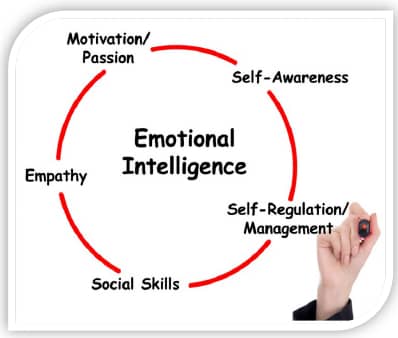
The term emotional intelligence (EI) has become a recognized buzzword in business today, even though its definition remains somewhat misunderstood. EI has received increasing attention since 1990 when the first scientific paper was published on the topic. While many conflicting EI theories continue to be debated within the scientific community, human resources (HR) professionals are left without a standardized model to use for training purposes. In fact, some question whether EI can be learned or developed at all, or whether it is mostly innate like intelligence and personality.
Learning about EI = Development of EI
According to Nobel laureate Daniel Kahneman, humans have one very logical thinking process and another “thinking” process that operates automatically. Traditionally human nature was considered mostly rational with emotions being a departure from that rationality. More recent research has shown that the gap between thoughts and emotions is narrowing and may be inextricably intertwined. It further suggests that cognitive knowledge can be transformed into emotional knowledge, and emotional knowledge can be transformed into cognitive knowledge. While there are many implications of such a theory, one for HR professionals may be that the process of learning about EI alone can result in the development of EI. If learning about EI is tantamount to developing emotional knowledge, then people can be held accountable to apply the concepts after training.
EI Training Works
HR professionals can make a difference by giving people a basic understanding of EI to best shape their jobs and their lives. Research findings have concluded that EI training has a moderate effect on EI for employees and managers. In particular, senior managers who received EI training demonstrated significant improvements in their ability to perceive, understand, and accept their own and others’ emotions in an effective way. In addition, it helped them manage stress, have a positive attitude, and control and manage their own emotions. In one study, Delphine Nelis found that EI training significantly improved emotion regulation, comprehension, and general emotional skills. It also had a positive impact on psychological well-being, subjective perceptions of health, quality of social relations, and employability. Similarly, several studies that have been conducted within the workplace have shown that EI can be improved through training and have underscored the key role that it plays in effective performance.
Training Recommendation
Studies completed by Peter and Brinberg, and Gilar-Corbí et al., suggested that EI training may be more effective with increased time for more exercises to produce larger training effects. They also suggested that participants needed more experience and opportunities to practice EI skills. To this end, several training studies incorporated multi-modal delivery. For example, Gilar-Corbí et al. utilized both face-to-face training and a virtual support system among participants in addition to virtual individualized training.
EI for Stress Management and Change
While there are many off-the-shelf course offerings for EI, HR professionals can apply the basics of EI education in regards to stress management. One aspect of this is emotional competence, the extent to which people are aware of their emotions. How we understand and express ourselves is fundamental to building a wide range of interpersonal competencies, and it is challenged by the stress we face in all areas of life. Coping with stress involves cognitive and behavioral strategies and the right emotional resources to make it a positive experience instead of a negative one. Thus, EI training from HR professionals can help people more successfully cope with stress by equipping them with the tools to become aware of their own emotional landscape.
Additionally, EI training can be used to help people prepare for change. The key for this kind of training is understanding motivation and the related behavioral patterns. With the application of the appropriate feedback information and the development of emotional competencies, it becomes possible to manage ourselves and our relationships with others so that we truly live out our intentions. This is particularly important for the leaders in an organization whose EI has been found to account for 85% of their success (Jofreh, 2013). Leaders who are equipped with emotional competencies can then coach and train their team members dealing with change.
Contact VisionCor Solutions
If you are in need of assistance to implement EI training in your organization, VisionCor has the professional expertise you need. From custom design to delivery, VisionCor consultants are qualified to provide impactful EI Training. Reach out today and let us help you take your organization to the next level.


References
Badenhorst, A., & Smith, D. (2007). Misconceptions about emotional intelligence: Deploying emotional intelligence in one’s life dimensions. Journal of Human Resource Management. Retrieved from http://www.sajhrm.co.za/index.php/sajhrm/article/view/146
Bratianu, C., & Orzea, I. (2014). Emotional knowledge: The hidden part or the knowledge iceberg. Management Dynamics in the Knowledge Economy, 2(1), 41-56. Retrieved from http://managementdynamics.ro/index.php/journal/article/viewFile/51/44
Jofreh, M. (2013, July 5). The effect of emotional intelligence on optimized management in organizations. Journal of Applied Sciences, 6, 1144-1146. Retrieved from http://maxwellsci.com/jp/abstract.php?jid=RJASET&no=324&abs=02
Ramesar, S., Koortzen, P., & Oosthuizen, R. M. (2009, May 5). The relationship between emotional intelligence and stress management. Original Research, 35(1), 39-48. Retrieved from http://www.sajip.co.za